
Ice baths in Singapore: Your complete guide to cold plunge benefits, safety and where to start
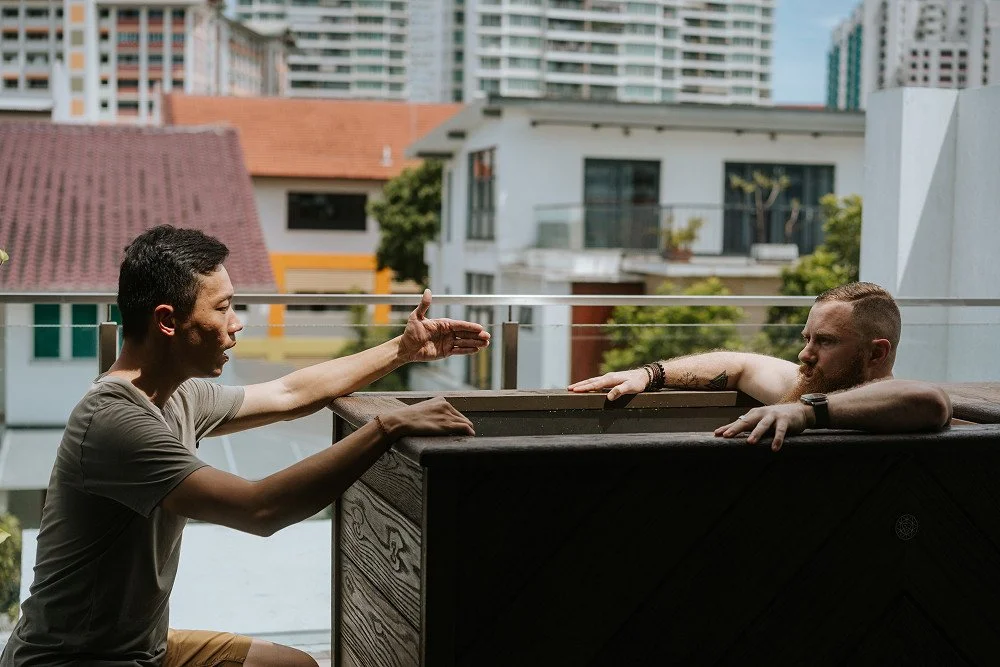
Ice bath guidance at Homing Inn
The moment your body hits 3°C water, your skin sends an immediate warning to the brain. Something difficult is happening. Your heart rate climbs. Your muscles tighten. Your thoughts begin to scatter and you gasp for control. The cold does not ask for permission.
Then you take a long exhale. Then another. You remind yourself that this panic is temporary. The brainstem is doing exactly what it was designed to do. You are not in danger.
In about sixty seconds, something shifts. The bite of the water softens. Your shoulders drop. An audible sigh escapes. Your body stops fighting and starts adapting. What was a threat becomes, in the most literal biological sense, a teacher.
That is what a cold plunge feels like when you do it correctly. Not a dare. Not a ‘content’ moment. A deliberate conversation between your nervous system and a stressor that, with the right preparation, leaves you calmer, sharper and better resourced than before you went in.
Ice baths in Singapore are no longer a niche curiosity. The Straits Times reported in 2024 that cold plunges have moved firmly into the mainstream, with dedicated venues opening across the city and one ice bath equipment provider recording a 300 percent increase in sales within a single quarter.
CNA's Mental Health Matters series covered the same cultural shift in April 2024, in a piece titled "Gen Zen: Is how we breathe how we feel?" The journalist attended one of my sessions and experienced the Wim Hof Method firsthand. What I told him then still holds: breathwork gives the body a much wider bandwidth for understanding what stress and relaxation actually feels like. When you enter cold water after a proper breathwork primer, you already have the tools to manage the stress response rather than be overwhelmed by it.
I started teaching breathwork and cold exposure in Singapore in 2019. Not because it was trending. I first came across the Wim Hof Method in 2016. A few cold water experiences in Nepal and Hokkaido showed me how powerful it felt to accomplish something your body had told you was impossible. I wanted to find a real instructor rather than learn from a computer recording, but the Wim Hof academy told me there were no certified instructors in Singapore. So over the next two years I studied the material, trained in Amsterdam and Poland, and became the first.
Early classes ran from my home studio in Pemimpin. I worked alongside Altered States to co-create workshops that introduced many first-timers to the method under certified guidance. As the ice bath scene grew, I facilitated at Soma Haus and Rekoop. I also trained the first batches of staff at The Ice Bath Club, so that the people coming through those doors would have instructors who understood the physiology behind what they were facilitating, not just the temperature of the water.
I am not sharing this to establish credentials for their own sake. I am sharing it because when someone is guiding your nervous system through an acute stressor, context matters.
Most ice bath experiences in Singapore are missing the most important part
The growth of cold plunge culture here is genuinely good news. More people are discovering that deliberate physical stress, applied correctly, produces real and measurable effects on the body and mind. The problem lives in that word: correctly.
Most venues operate on what I call a dip-and-go model. You arrive, you are shown the tub, you get in. Sometimes an instructor encourages you to keep pushing. Sometimes there is ambient music. Most times there are lots of people going back and forth, some individuals staying for very long durations in extreme cold, others chatting with each other excitedly as they catch up on each other's lives.
The Straits Times noted that sessions at most Singapore establishments run between 30 and 60 minutes, priced from $35 to $115. What is almost never included in that time is preparation. And preparation is the entire mechanism.
Here is what the marketing around cold plunges consistently leaves out. Cold water immersion is an acute stressor. When you enter without preparation, your body triggers a cold shock response. Your toes might hurt painfully. Breathing becomes involuntary and rapid. Heart rate spikes sharply. If your CO2 tolerance is already low and your nervous system is running at high arousal from a difficult day, that spike can tip into hyperventilation. In open water, that is a drowning risk. In a controlled facility, it is simply an unpleasant and physiologically unproductive experience that will likely discourage you from returning.
The benefits that have attracted serious scientific attention, including improved vagal tone, elevated norepinephrine output, reduced inflammatory markers and enhanced stress resilience, are not the result of a single ice bath. They are the result of consistent, prepared practice. The person who builds a cold exposure habit over weeks and months with proper breathwork and progressive coaching is having a fundamentally different physiological experience from the person who dips once for social media. Same temperature. Completely different outcome.
This is the distinction worth understanding clearly: an ice bath facility gives you access to cold water. Guided cold exposure coaching gives you a trained nervous system.
What actually produces results: The 3 Pillars
Pillar 1: Breathwork preparation
Breathwork comes before cold exposure for mechanical reasons, not ceremonial ones. A proper protocol, whether based on the Wim Hof Method, the Oxygen Advantage framework, or Flow Science coaching, systematically reduces your CO2 sensitivity and activates the parasympathetic nervous system before the stressor arrives. In practical terms: you enter the water from a calmer physiological baseline. The cold shock response is significantly blunted. You stay in longer, you stay in control, and the hormetic stimulus lands cleanly instead of triggering panic. The breathwork is not a warm-up ritual. It is the primary mechanism.
Pillar 2: Gradual temperature and duration progression
Cold exposure follows the same logic as strength training. Showing up once and going as hard as possible produces discouragement and abandonment. Consistent, progressive exposure over weeks produces adaptation. Your body learns to vasoconstrict efficiently, to mobilise brown adipose tissue for heat generation, to regulate core temperature with less overall effort. Even your fingers and toes learn to send less pain signals upon initial contact. That adaptation is what produces lasting changes in mood, metabolism, immune function and stress resilience. Not the photograph of someone gritting their teeth in a tub.
Pillar 3: Mindset coaching during the exposure itself
The sixty to ninety seconds after you enter the water are not passive. They are one of the highest-leverage windows for mental training I have encountered in any modality. The cold forcefully pulls attention away from abstract worry and into the body. It creates attentional narrowing in the most useful sense: for most of the executives and high-performing professionals I work with, this is the first moment of genuine presence they have had in weeks. Learning to work with that state rather than against it, to move through discomfort with deliberate breathing and focused attention rather than brute endurance, is a transferable skill with direct application to every high-pressure situation that follows you out the door.
Why Singapore's climate makes cold exposure more potent
There is a counterintuitive advantage to practising cold exposure in a country that sits at 34°C for most of the year. The temperature differential between your ambient environment and a 3°C ice bath is extreme. That differential is precisely what creates the hormetic stimulus.
Hormesis is the biological principle by which a controlled, moderate stress triggers an adaptive response that leaves the organism stronger than before the stress was encountered. The greater the contrast between baseline and stressor, the stronger the initial signal and the more pronounced the adaptation. Singaporeans who build a regular cold exposure practice are working with a larger hormetic stimulus than their counterparts in northern Europe, where the gap between ambient and cold is far smaller. Done with proper preparation, this amplifies adaptation rather than overwhelming the system.
The climate that most people assume makes cold exposure impractical here is actually an asset.
The physiological cascade: What is actually happening inside the water
When you enter cold water after breathwork preparation, the sequence unfolds like this. Cold contacts the skin and triggers sympathetic activation: the system gears up for threat. But because your breathwork has already raised your CO2 tolerance and lowered your baseline arousal, you do not spiral into a panic response. Trained breathing brings the parasympathetic system online. The cold provides the hormetic stress. Your body adapts in real time.
Over repeated sessions, the long-term adaptation takes hold: improved heart rate variability, better inflammatory regulation, more efficient stress response architecture. The neurochemical profile shifts away from cortisol and adrenaline toward dopamine, norepinephrine and anandamide. This is not a metaphor for feeling good after a cold shower. These are specific, measurable chemical changes with documented effects on mood, motivation, focus and pain perception.
The cold resets your body. More usefully, it resets your relationship with discomfort. That change follows you out of the water and into the rest of your day.
What the data from sessions shows
In one group session at Homing Inn, participants had their blood pressure measured before and after a guided breathwork and ice bath sequence. On average, blood pressure dropped 15 points across the group. That sits within the range of what pharmacological intervention produces for mild hypertension, achieved without medication, in a single session.
One individual came to the practice after more than a decade of daily painkillers for a painful autoimmune condition. After completing a structured programme of breathwork and regular cold exposure, he is now completely off the painkillers. The mechanism is specific rather than mysterious: chronic sympathetic nervous system activation amplifies inflammatory signalling. Consistent parasympathetic activation through breathwork and cold exposure interrupts that cycle for some individuals. His case is consistent with the emerging research on vagal nerve stimulation and inflammatory modulation.
These are not guarantees or clinical claims. They are what happens when the physiology is respected and the practice is consistent.
What to expect at your first 90-minute session at Homing Inn
Arrival and consultation: The first half
The first half of the session is built entirely around nervous system safety. We sit down together. There is no hurry. The conversation is casual but I am listening carefully: how your body has been feeling, what is pressing on your mind, what you are hoping to get from this and what you are apprehensive about. That information shapes everything that follows, including the breathwork protocol and the approach to the cold.
Breathwork
We move into breathwork. A few guided, paced rounds. The goal is not to push you into an altered state for its own sake. The goal is to bring your CO2 tolerance to a level where the cold water is manageable from the first second rather than overwhelming. Most people are surprised by how settled they feel before we even approach the tub. To some stressed individuals, the breathwork session alone is their biggest reward of the week.
The Plunge
The second half is cold exposure, always sequenced after breathwork because the potential stress of cold requires the client to be significantly calmer than their resting state. That level of calm is not easily reached alone at home or in a crowded wellness venue. Here, you arrive at the water already prepared.
Within the first minute or two of the plunge, the sharpest sensation passes. A focused calm takes its place. This is the neurochemical shift in action. The cold has pulled the mind completely away from habitual worry and into the present moment. This physiological reset makes it easier for the subconscious to do what it does best: pattern recognition, creative problem solving, perspective on problems that felt stuck.
The afterglow and takeaway
After you get out, we use that window deliberately. There is a period of relaxed mental clarity, sometimes called the afterglow, where many issues can be approached with noticeably greater ease. Even when that does not happen on a conscious cognitive level, the physical exertion of the session creates the conditions for unusually deep sleep that evening and renewed energy the following morning.
You leave with a clear understanding of what happened physiologically and with practices you can apply at home from the next day.
Ice baths are the entry point
Cold exposure is a powerful and accessible gateway into the broader practice of deliberate physiological management. Many clients who arrive here because they read about ice baths stay because they discover that breathwork and mindset coaching are what truly transform their performance under sustained pressure. The cold accelerates everything. The breathing is what makes it last.
If you are ready to start:
Come for our regular group sessions
If you prefer a deeper private session, Whatsapp for a private class booking
It is the most direct way to experience the science in your own body, with guidance that ensures the session is productive rather than just uncomfortable.
If what you are looking for goes beyond a single reset and into consistent, coached performance architecture, the Flow Coaching programme builds on exactly this foundation over six or twelve weeks.
The cold is not the point. What the cold teaches you about your own nervous system is.
Read more about ice baths here.
