
Ice Bath Therapy for Mental Health: Benefits, Evidence & What to Expect at Homing Inn
At Homing Inn, our ice bath sessions in Singapore are designed around the latest research on cold water immersion and mental health. That sentence matters, because the ice bath industry is full of claims that outrun the evidence. Our approach is different. We read the studies, we build our protocol on what they actually show, and we tell you plainly where the science is strong and where it is still emerging.
If you are searching for how cold water immersion affects mood, anxiety and stress, here is what the research says and how we apply it at our studio in Bishan.
The Science
Three findings come up consistently across the peer-reviewed literature.
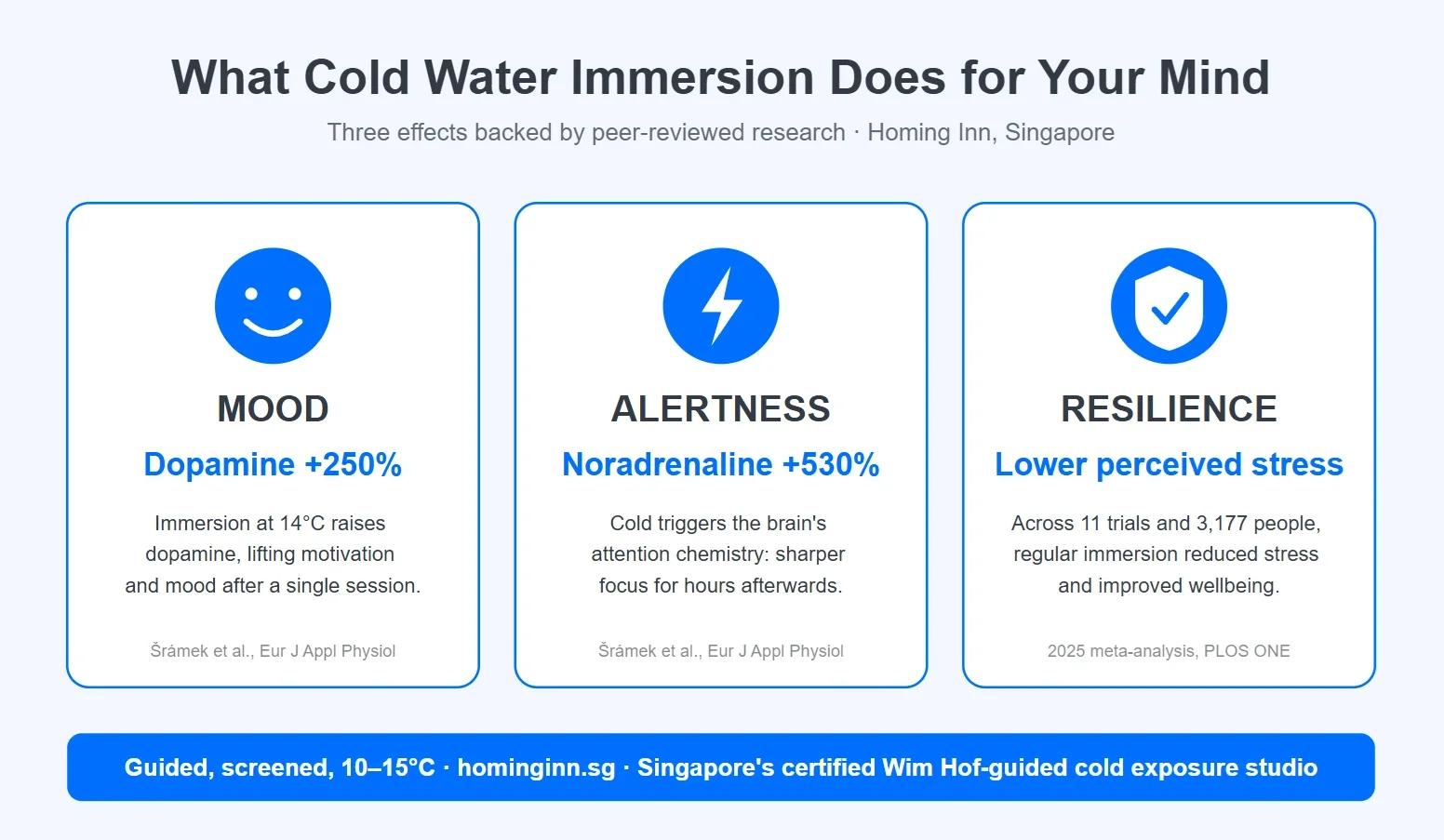
Cold water changes your brain chemistry, fast. Immersion in water around 14°C has been shown to raise plasma noradrenaline by roughly 530% and dopamine by roughly 250% (Šrámek et al., 2000, European Journal of Applied Physiology). Noradrenaline drives alertness, attention and mood regulation. Dopamine drives motivation and the sense of reward. This is the mechanism behind the clear-headed, energised state people describe after a plunge. It is measurable, repeatable physiology.
The mood effect is real, and reviewed at the clinical level. A 2024 review in BJPsych Advances, the continuing-education journal of the Royal College of Psychiatrists published by Cambridge University Press, examined contemporary applications of cold water immersion in the treatment of clinical depression and anxiety (Carona & Marques, 2024). The authors trace a line from single-session mood improvements through to structured protocols being explored as adjunct treatments. The framing is careful: cold water immersion is a promising complement to established care, and the field needs larger controlled trials. That caution is exactly why we take the research seriously rather than overselling it.
Across trials, the strongest signals are stress reduction and wellbeing. A 2025 systematic review and meta-analysis published in PLOS ONE and indexed on PMC pooled 11 randomised trials with 3,177 participants, covering immersion at 7°C to 15°C (Cain et al., 2025). It found reductions in perceived stress and improvements in quality of life and wellbeing, alongside honest acknowledgement that effects on some outcomes vary by protocol and timing. A separate brain-imaging study found that a single immersion increased connectivity between brain networks involved in emotional regulation, with participants' ratio of positive to negative emotion roughly doubling after the plunge (Yankouskaya et al., 2023).
The picture across these sources is consistent. Cold water immersion reliably shifts the neurochemistry of alertness and mood, reduces perceived stress with repeated practice, and shows early clinical promise for depression and anxiety as a supervised, structured practice.
What This Means for You
Research findings only translate into results when the protocol matches the studies. At Homing Inn, every session is built to mirror the conditions the evidence describes.
Temperature. Our plunge is maintained between 10°C and 15°C, the same range used in the trials above. Colder is not better. The neurochemical response is triggered well within this range, and going far below it raises risk without adding benefit. Only upon request will we bring the temperature down to as low as 3°C.
Duration. Immersions are short and deliberate. Beginners typically hold one to two minutes, which is enough to trigger the full noradrenaline and dopamine response. We progress duration only as your cold tolerance and breath control develop.
Breath first, water second. Every session begins with guided breathwork. The single biggest difference between a stressful plunge and a regulating one is what your breathing does in the first thirty seconds. We train that before you touch the water, so the immersion becomes practice in staying calm under a real stressor rather than an endurance stunt.
Supervision throughout. A certified instructor is beside the tub for the entire immersion. Chun Tan, our founder, is Singapore's first Advanced certified Wim Hof Method instructor and a certified Oxygen Advantage instructor, and every Homing Inn session runs under that standard.
Safety First
Cold water immersion is a genuine physiological stressor, which is precisely why it works and precisely why it needs screening.
Cold immersion is not appropriate for people with cardiovascular conditions, uncontrolled hypertension, arrhythmias, a history of stroke or heart attack, cold urticaria, Raynaud's disease, or epilepsy, and it is not recommended during pregnancy. The initial cold shock response raises heart rate and blood pressure sharply in the first moments of immersion, which is manageable for healthy adults and hazardous for these groups.
However even healthy adults do experience moments of dizziness, lethargy or confusion when they go from warm to cold, especially when without trained guidance.
At Homing Inn, every first-time guest completes a health screening questionnaire before entering the water. We ask about the conditions above, current medications and recent illness. If anything in your screening raises a flag, we will ask you to get your doctor's clearance first. We would rather delay your first plunge than compromise your safety. During the session, you are never immersed alone, entry and exit are always guided, and you can end the immersion at any moment.
Facilitator-Led vs DIY
You can buy a chest freezer or baby pool and fill it with ice at home. People do. Here is why we built a guided studio instead.
The DIY approach fails at the exact points that make cold water immersion valuable for mental health. Without breath coaching, the cold shock response wins, the session becomes a panic rehearsal, and many people quietly quit within two weeks. Without screening, the contraindications above go unchecked. Without supervision, the two highest-risk moments, entry and the minutes after exit, happen with nobody watching. And without progression, people either stay too shallow to trigger the adaptation or push too far and reinforce the stress response they came to fix.
A guided session at Homing Inn gives you the researched temperature range, a trained instructor managing your breathing in real time, a screening process that has already ruled out the risks, and a progression plan so each visit builds on the last. The studies showing mental health benefits used supervised, structured protocols. That is what we deliver.
Ready to experience it? Book a guided ice bath session at our Bishan studio, or read about our Wim Hof Method Fundamentals workshop if you want the full theory, breathwork and cold immersion in one morning. You can also find DIY options in our blog Where to do ice baths in Singapore.
References
Carona, C., & Marques, S. (2024). Beyond the cold baths: contemporary applications of cold-water immersion in the treatment of clinical depression and anxiety. BJPsych Advances, 30(5), 271–273. Cambridge University Press. https://www.cambridge.org/core/journals/bjpsych-advances/article/beyond-the-cold-baths-contemporary-applications-of-coldwater-immersion-in-the-treatment-of-clinical-depression-and-anxiety/F285E3B83C4D0E43D10883021BCDD55F
Cain, T., et al. (2025). Effects of cold-water immersion on health and wellbeing: A systematic review and meta-analysis. PLOS ONE. https://pmc.ncbi.nlm.nih.gov/articles/PMC11778651/
Šrámek, P., et al. (2000). Human physiological responses to immersion into water of different temperatures. European Journal of Applied Physiology, 81, 436–442.
This article is for general education and is not medical advice. If you have a diagnosed mental health condition, cold water immersion should complement, never replace, care from your doctor or mental health professional.
